

By Shakespearean Translator
You’ve probably heard the line even if you’ve never sat through the play. “Get thee to a nunnery.” Hamlet fires it at Ophelia in Act 3, Scene 1 — not once, not twice, but five times in a few minutes, each one harder than the last. At its plainest it just means “Go and live in a convent.” Except it isn’t plain at all: “nunnery” carried a second, much uglier meaning in Shakespeare’s day. That’s where it gets interesting.
Quick answer: “Get thee to a nunnery” means “Go away and join a convent.” Hamlet’s ordering Ophelia to give up love and marriage and shut herself away from a corrupt world. But “nunnery” could also be slang for a brothel back then, so the same line can sound like concern — or like a slap.
Quick facts
- Speaker: Prince Hamlet of Denmark
- Spoken to: Ophelia, the young woman he’s been courting
- Play: Hamlet, by William Shakespeare
- Where: Act 3, Scene 1, soon after the “To be, or not to be” speech
- Said: five times in one scene
- Key line that follows it: “Why wouldst thou be a breeder of sinners?”
The meaning in plain English
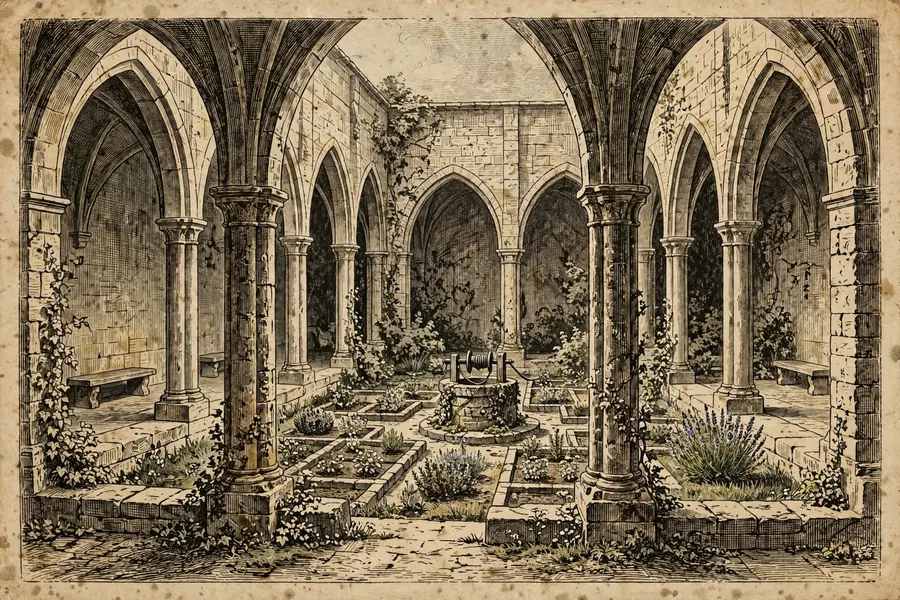
Start with the surface reading, because it’s bleak enough by itself. A nunnery is a convent: a house where nuns live together, pray, and give their lives to God. Nuns don’t marry; they don’t live among men either — the world stays on the far side of the wall. So this is no gentle suggestion: he’s ordering her to walk out of the court, abandon any hope of love or children, and shut the door behind her for good.
Three little words do most of the heavy lifting here, and they’re the ones that trip readers up:
- Thee is “you” — the familiar form, the one you’d use with someone you knew well.
- Get thee means “go,” or closer still, “take yourself off.” It’s a command. Not a request.
- Wouldst thou is “would you” — which is why the follow-up hits as a question: “Why would you be a breeder of sinners?”
Shakespeare wrote in Early Modern English, the language of about 400 years ago — close enough to follow, different enough to trip you every few lines. If thee and thou slow you down (you’re in good company), our guide to thou, thee, thy and thine untangles the whole pronoun set in plain terms.
So that’s the surface: the woman he once courted, told to lock herself away from men, marriage and children for life. It isn’t the whole story, though. Not even close.
The second meaning: insult or slang?
Here’s where it turns. “Nunnery” had a double life in Shakespeare’s London. Alongside the convent sense, the word could also serve as slang for a brothel — the polar opposite of a house of prayer — and plenty of editors and teachers have pointed this out. If that second meaning is in play, Hamlet isn’t shielding Ophelia from a corrupt world at all. He’s accusing her. Sneering at her, treating her purity as an act she’s putting on.
So which one does he mean? Honestly — scholars have argued it back and forth for ages, and nobody has settled it. The convent meaning is certain; it’s written all over the scene. The slang meaning is genuine period usage, but there’s no way to prove which sense he intends at any single repeat, and Shakespeare, being Shakespeare, may well have wanted the double meaning hanging in the air throughout. Hear only the convent and you miss the cruelty. Hear only the insult and you miss the odd, twisted scrap of care buried in it.
In the classroom, it helps to hold both senses at once. That isn’t a dodge. It’s how the line actually works on stage: Ophelia hears an order, and the audience hears a blade.
The scene behind the line
Ophelia doesn’t wander into any of this by chance — she’s been placed there. Her father, Polonius, and King Claudius want to know what’s behind Hamlet’s strange behavior, so they set her in his path like bait and hide to watch. Hamlet, meanwhile, has just finished the most famous speech in theatre, “To be, or not to be,” when he turns and finds her there.
She tries to give his things back — letters, gifts, the whole courtship. It starts softly. It doesn’t stay soft. “I did love you once,” he tells her, and for one breath the old Hamlet seems to be back. Then, almost in the next breath: “You should not have believed me.” He denies he ever gave her anything. He attacks her honesty, mocks the paint women wear, and under it all, one command starts drumming away: get thee to a nunnery.
Then the temperature drops. Halfway through, Hamlet stops — like a man who’s just felt eyes on the back of his neck — and asks: “Where’s your father?” Ophelia lies. He’s at home, she says. Many actors play everything after that question as a man performing for listeners he suspects are hidden nearby. Is the rage real? Is some of it theatre? The play never tells us — maddening and brilliant in equal measure.
He storms off. Ophelia, alone, gets the scene’s saddest line: “O, what a noble mind is here o’erthrown!” Notice what she blames. Not his heart — his mind. She’d rather believe she’s watched a noble reason crack than believe he meant a word of it.
The key lines in modern English
| Original line | In modern English |
|---|---|
| Get thee to a nunnery: why wouldst thou be a breeder of sinners? | Go to a convent. Why would you want to give birth to more sinners? |
| I am myself indifferent honest; but yet I could accuse me of such things that it were better my mother had not borne me. | I am fairly honest, yet I could charge myself with such faults that it would be better if I had never been born. |
| Be thou as chaste as ice, as pure as snow, thou shalt not escape calumny. | Even if you were as pure as ice or snow, people would still slander you. |
| Get thee to a nunnery, go, and quickly too. Farewell. | Go to a convent. Go now, and hurry. Goodbye. |
| Where’s your father? | Where is your father? (Hamlet suspects he is being spied on.) |
Want the whole play in this plain style? Read Hamlet in modern English scene by scene, original text right beside it.
Why Hamlet repeats the line five times
Say it once and the point is made. Hamlet says it five times. Why? Because the repetition is the psychology: each return tells you something the words alone don’t.
Start with where the anger is actually aimed: not at Ophelia. It’s aimed at his mother. Gertrude married Claudius — her dead husband’s own brother — within a month of the funeral, and for Hamlet that one act rots everything: women are frail, love is a performance, trust is a joke. Ophelia just happens to be standing in front of him when it boils over, so she takes blows meant for someone else. Unfair? Completely. And the play knows it.
Then there’s the line that hands you the key: “Why wouldst thou be a breeder of sinners?” Follow the logic, grim as it is. As Hamlet sees it just now, everyone born grows up corrupt — so every marriage, every child, just stocks the world with more sinners. A convent breaks the chain: if Ophelia never marries, never has children, the cycle stops dead with her. Seen that way the command isn’t only cruelty; in his head it might be the one clean door left standing.
Or — he’s acting. Suppose he’s worked out that Polonius and Claudius are hidden away listening — that sudden “Where’s your father?” rather suggests it. Then every repetition does a job: a ranting, lost-sounding prince is one nobody bothers to plot against. Each shout sells the madness a little harder. And buys him time.
Finally, listen to the sound of it. First time round it’s advice — brutal advice, granted, but advice. By the fourth or fifth it stops sounding like an instruction and starts sounding like a mind stuck in a groove, stuck on the only sentence it can still say. By then it isn’t about Ophelia anymore. It’s about a man who can see no way out of the world, for her or for himself, except a convent door slamming shut.
How actors play the scene
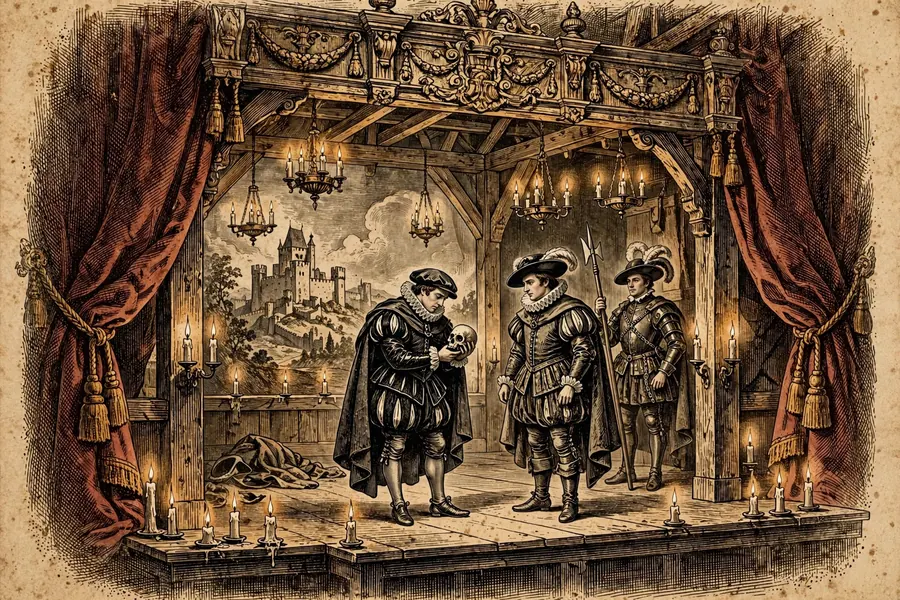
No two Hamlets deliver the line alike, and the choice quietly rewrites the play. Some roar it — seize her, shake her, turn it into an outright attack, and when Ophelia falls apart later you feel this moment still sitting on her like a bruise. Others go the other way: low, close, almost gentle — a warning, really: get out of this court while you still can, before it eats you the way it’s eating me. That version turns cruelty inside out: a rescue attempt.
Most productions, mind you, split the difference. The first “get thee to a nunnery” stays soft — that one’s for her. Then he catches something — a sound, a shadow — and after “Where’s your father?” the rest come out loud and wild, aimed at the men in hiding. If you watch the scene on stage or screen, watch his eyes on that question. That’s where the turn is buried.
What the scene sets in motion
This scene is the hinge the whole play swings on. Afterwards Ophelia does everything her father tells her, but the man she loved is gone, so is the future she’d imagined, and there’s nothing solid left under her. Then Polonius is killed — by Hamlet’s hand, of all hands. What’s she supposed to hold on to after that? Her broken songs, her flowers, her death in the brook: all of it grows out of this scene. That’s why one short command, shouted five times inside a trap, is worth a whole guide. It’s the moment the love story dies — well before either lover does.
How the phrase is used today
People still quote it, though hardly ever in earnest. It turns up as a joke between friends, in memes, in essays on the play — a fancy, mock-old-fashioned way of telling somebody to back off or calm down.
One caution. Out of context, the line is an insult about a woman’s character, and if the slang meaning is riding along, it’s uglier than it sounds. As a joke among friends who know the play? Fine. Aimed at someone mid-argument, it can land as a real slur. Quote it for fun, quote it for study — just know what you’re saying before you say it.
Frequently asked questions
What does “get thee to a nunnery” mean in simple words?
“Go and live in a convent.” Hamlet is ordering Ophelia to leave the court, give up marriage and love, and spend her life as a nun — withdrawn from the world for good.
Was “nunnery” really slang for a brothel?
Very likely, yes — though it’s debated rather than proven. Editors have noted for a long time that “nunnery” could carry that slang sense in Shakespeare’s time, and it’s widely taught. The safest way to hear the line is with both senses running at once: convent on the surface, insult underneath.
How many times does Hamlet say “get thee to a nunnery”?
Five times, all in Act 3, Scene 1. The wording wobbles slightly — “Get thee to a nunnery” here, “To a nunnery, go” there — but it’s the same command each time, landing harder with every repeat.
Did Hamlet love Ophelia?
The signs point to yes — or at least, to once. At Ophelia’s grave in Act 5, grief pours out of him: “I loved Ophelia: forty thousand brothers could not, with all their quantity of love, make up my sum.” Which is exactly what makes the nunnery scene so painful: love curdled by grief, rage and suspicion.
What does Ophelia say after the line?
Very little — and that’s rather the point. Hamlet does nearly all the talking. Once he’s gone, Ophelia laments alone: “O, what a noble mind is here o’erthrown!” She believes his reason has snapped, and she mourns the courtier and soldier she once knew.
Is a nunnery a real place?
Yes. It’s another word for a convent — a real home where nuns live under vows of prayer and chastity. Convents stood all over Europe in Shakespeare’s time, though England’s own had been shut down by Henry VIII decades before the play was written.
About this guide and sources
We put this guide together for the student who runs into this line in class, stares at it, and thinks: wait — what? The quotations come from Hamlet itself, which is in the public domain, and the wording follows the Folger Shakespeare Library edition of the play. For the word senses we leaned on David Crystal’s Shakespeare’s Words, the standard glossary of Shakespeare’s language. The reading here — holding the convent sense and the slang sense together instead of picking a winner — is our own, offered up for classroom debate.
Still stuck on a line? Paste it into the free translator on our homepage and see it in modern English at once.